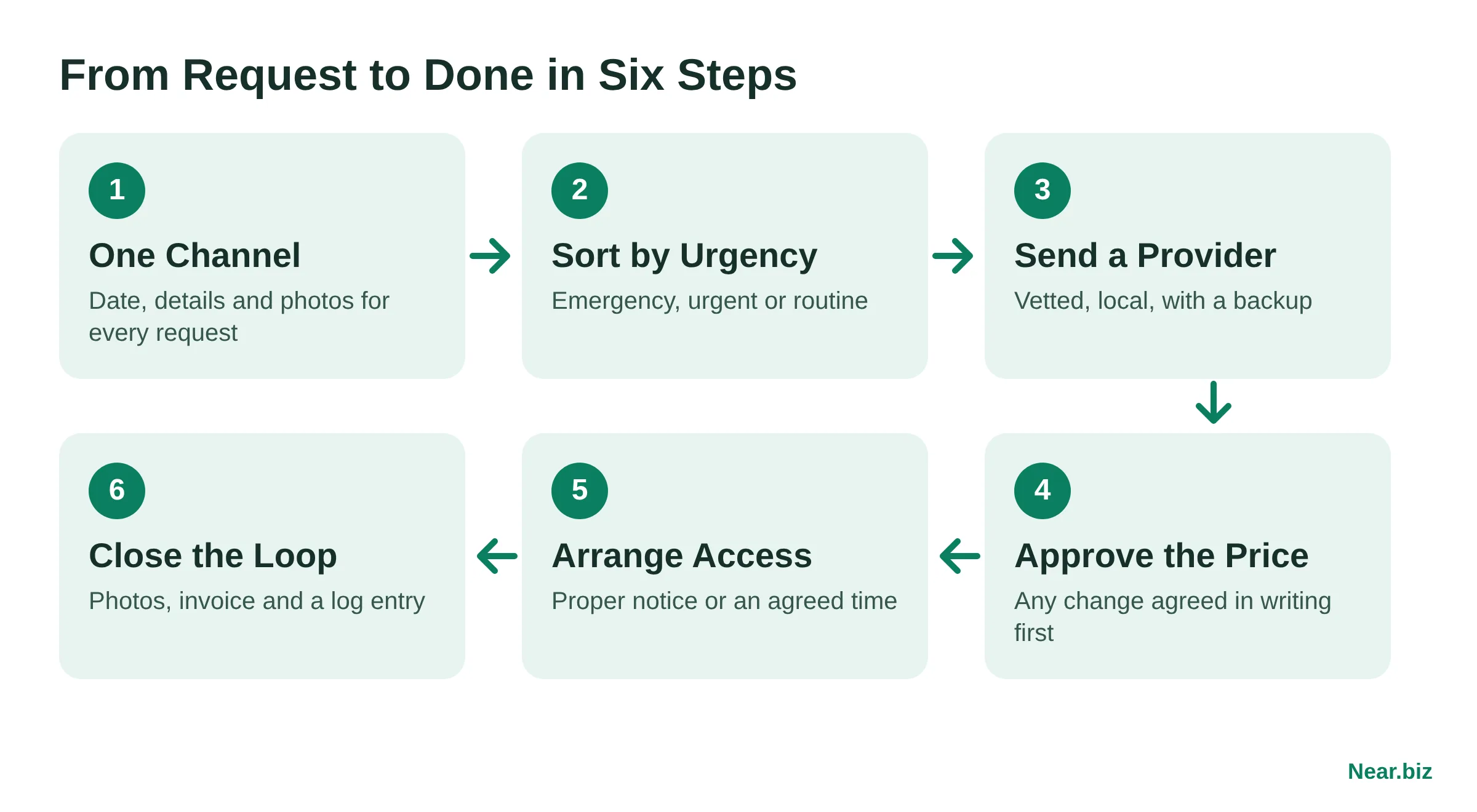
To handle rental property maintenance requests from far away, run every request through one channel, sort it by urgency the same day, send a vetted local provider, approve the price before work starts, arrange entry with proper notice, and close the job with photos and a log entry. Each step keeps a small problem small.
This guide shows remote landlords how to handle maintenance requests step by step. It is written for owners who rent out a home in San Jose, Palo Alto or the cities between and live somewhere else. We are Near.biz, a booking platform for home services in that area, so the examples and rules are Californian. For the bigger picture of looking after a rental from another city, start with our rental property maintenance guide for out-of-town landlords.
Written by Tehreem for Near.biz. Last updated November 2026. Legal references were checked against the California Civil Code.
In this guide
- Why Maintenance Requests Go Wrong When You Live Far Away
- Step 1: Take Every Request Through One Channel
- Step 2: Sort the Request by Urgency
- Step 3: Send a Vetted Local Provider
- Step 4: Approve the Price Before Work Starts
- Step 5: Arrange Access With Proper Entry Notice
- Step 6: Close the Loop With Photos and a Log
- California Rules That Set Your Repair Clock
- When a Request Is Not a Repair
- Plan for Requests That Come at Night
- An Example: A Leak on a Friday Night
- Rental Property Maintenance Requests FAQ
Why Maintenance Requests Go Wrong When You Live Far Away
A tenant maintenance request is harder to handle from a distance for three reasons: you cannot see the problem, you cannot let anyone in yourself, and you cannot check the work. A text that says “the sink is leaking” could mean a slow drip or a flooded cabinet. The six steps below replace each missing piece with a habit.
Step 1: Take Every Request Through One Channel
Ask tenants to report every repair the same way, whether that is a repair request form, an app or a shared inbox, and never a mix of texts, calls and emails. One channel gives each request a date, a description and photos in one place, so nothing gets lost and you have a record if a question comes up later.
Ask tenants to include:
- What is wrong and where in the home
- When it started and whether it is getting worse
- Photos or a short video, including one wide shot of the area
- Any safety risk, such as water spreading, sparks, a burning smell or no heat
- What they have already done, such as turning off a valve or switching off a breaker
- Good times for a visit, and anything a provider should know about pets, parking or access
Put these questions in the form itself. Tenants answer what they are asked, and a complete first message saves a day of back-and-forth when you are in another time zone. Reply to every request the same day, even if the only message is that you are on it.
Step 2: Sort the Request by Urgency
Sort each request into one of three levels before you act: emergency maintenance that threatens safety or the home, an urgent repair that affects daily living, or routine work that can be scheduled. The level decides how fast you move, who you call and whether a cost needs your approval first.
| Level | Examples | Suggested reply | Suggested fix window |
|---|---|---|---|
| Emergency | Burst pipe, water spreading, a gas smell, sparks or a burning smell, no heat in cold weather, sewage backing up, a door that will not lock | Right away | Make safe the same day |
| Urgent | No hot water, fridge not cooling, the only toilet not flushing, heating weak but working | Same day | Within a few days |
| Routine | Dripping faucet, loose cabinet door, slow drain, worn caulk | Within a day | Scheduled, within 30 days |
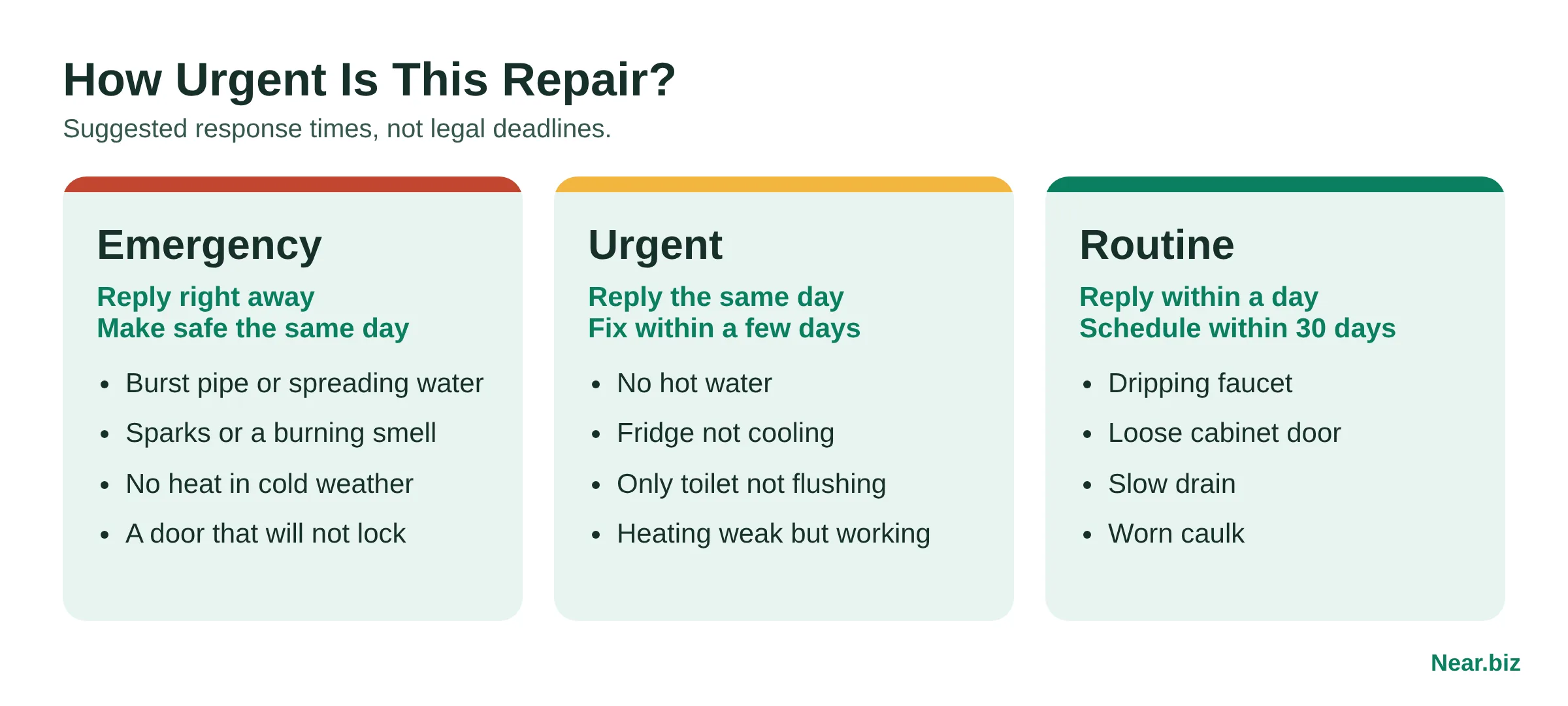
These windows are our suggestions, not legal deadlines. For non-urgent repairs, the City of Palo Alto’s tenant and landlord guide describes about 30 days as a reasonable window. Your lease can set shorter targets, and tenants notice when you keep them.
What Your Tenant Should Do First
Give tenants a short move-in sheet that says what to do before they contact you:
- Water leak. Turn off the valve under the fixture, or the main water shutoff, and tell them where both are.
- Sparks or an electrical burning smell. Switch off the breaker if it is safe to do so, and call 911 if there is smoke or fire.
- Gas smell. Leave the home, call 911, then call PG&E at 1-800-743-5000, as PG&E’s gas leak guidance says. Contact you after that.
For leaks and clogs, our post on common plumbing issues and how to prevent them covers the usual causes.
Step 3: Send a Vetted Local Provider
Once you know the level, send a provider you checked before anything broke, ideally one for each trade you need. Look for a confirmed identity, any license or insurance the law requires for that work, clear pricing, and a habit of reporting back with photos. Keep a backup name for emergencies in case your first choice is busy.
If you would rather not keep that list yourself, Near.biz offers rental property maintenance services you can book online. You describe the job and the address, see an estimated price and scope, and approve it. We send the request to independent local providers who cover that address, and Near.biz checks each provider’s identity before they can take jobs. Our Trust and Safety page explains the checks. We do not do the work ourselves, and we cannot promise that a provider accepts every job or how soon, so keep your own emergency backup as well. If you want someone to handle rent and tenants too, our post on what makes a property manager efficient explains what to look for.
Step 4: Approve the Price Before Work Starts
Set an approval limit in advance: an amount under which a provider can go ahead, and above which they must send an estimate and wait for your yes. Put any change in price or scope in writing before extra work starts. This keeps small jobs moving and stops surprise bills when you are not there to look.
Choose the limit with your budget and the age of the home in mind, and tell every provider what it is. In an emergency, approve making the home safe first, then decide on the full repair once you have photos and a quote.
On Near.biz, the price you approve is final unless you approve a change, and any change to price or scope needs your written approval in Near before the extra work begins. Payment is collected only once a provider accepts the job.
Step 5: Arrange Access With Proper Entry Notice
In California, a landlord or provider generally needs to give the tenant reasonable written notice before entering for repairs, and 24 hours’ notice to enter is presumed reasonable. The notice states the date, the approximate time and the reason, and the visit happens during normal business hours. Emergencies are the main exception and need no notice.
Two details make this easier from far away. First, under Civil Code 1954, a tenant can agree orally to a repair visit if you set the date and approximate time, and the visit falls within one week of that agreement. A short message confirming the time, sent through your one channel, gives you a record. Second, if nobody will be home, decide how the provider gets in, such as a lockbox, a smart lock code or a neighbor with a key.
When you book through Near.biz, you can add access instructions at checkout, such as a lockbox note or a request to call first. The provider then contacts the person at the service address to set a time. Either way, tell your tenant who is coming and when.
Step 6: Close the Loop With Photos and a Log
A rental maintenance request is finished when you have before and after photos, the invoice, and a quick yes from the tenant that the problem is fixed. Add a line to your maintenance log with the date, the problem, the provider, the cost and a link to the photos, then check in with the tenant a few days later.
A log is the simplest way to track maintenance issues for a rental property, and it turns repairs into planning. After a year it shows which problems keep coming back, what to budget and which providers did good work. It also gives you a dated record if you and a tenant later disagree about the condition of the home. Our rental property maintenance guide includes a simple log layout you can copy.
California Rules That Set Your Repair Clock
California law gives tenants a remedy when a landlord does not fix a problem that makes the home unlivable within a reasonable time. Under Civil Code 1942, a tenant who has given notice may make the repair and deduct the cost from rent, and acting after 30 days is presumed reasonable. A serious problem can justify less.
Repair and deduct. The cost cannot be more than one month’s rent, and a tenant can use this remedy no more than twice in 12 months. It does not apply when the tenant caused the problem in ways the law describes. See Civil Code 1942.
No retaliation. For 180 days after a tenant complains about conditions in the home, a landlord may not raise the rent, reduce services or try to make the tenant leave in retaliation, within the limits set out in Civil Code 1942.5. A quick, polite response to every request keeps you well clear of this.
Habitability. Working plumbing, heating, electrical systems and hot and cold running water are part of what a landlord must keep up under Civil Code 1941.1. For leases that start on or after January 1, 2026, a working stove and refrigerator are on the list too, with a few exceptions.
For city rules, see the local rules for San Jose and Palo Alto in our guide. This is general information, not legal advice. If a request turns into a dispute, talk to a California landlord-tenant attorney.
When a Request Is Not a Repair
Not every request is yours to fix right away. A request to upgrade something that still works is a choice you can say yes or no to. Damage that a tenant or their guest caused is usually theirs to pay for under the lease. Either way, reply in writing, and fix anything unsafe first.
When the cause is unclear, ask the provider to note it on the invoice with photos. That keeps the conversation with your tenant about facts rather than opinions.
Plan for Requests That Come at Night
Urgent requests often arrive in the evening or on a weekend, when you may be asleep in another time zone. Before that happens, give your tenant one emergency number to call, line up a provider who answers after-hours calls, and keep a nearby contact who can open the door if needed.
An Example: A Leak on a Friday Night
This is an example, not a real client. Daniel lives in Seattle and rents out a two-bedroom condo in Sunnyvale. At 9 p.m. on a Friday, his tenant uses the request form to report water pooling under the kitchen sink, with two photos.
The move-in sheet showed the tenant where the valve under the sink is, so the water is off within minutes. With the leak stopped, Daniel marks the request urgent rather than an emergency. He books a plumber for Saturday morning, approves the estimate because it is under his limit, and confirms the visit time with his tenant in writing.
On Saturday the plumber replaces a cracked supply line and sends before and after photos. The tenant confirms the sink works, and Daniel adds a line to his log. It took a few messages and no flight.
Rental Property Maintenance Requests FAQ
What Is a Maintenance Request?
A maintenance request is a tenant’s report to the landlord that something in the rental needs repair or attention, such as a leak, a broken appliance or no heat. A good request is written, dated and includes photos, so the landlord can judge how urgent it is and send the right provider.
How Long Do Landlords Have to Respond to Maintenance Requests?
Reply to every request the same day, even if only to confirm you have it. Emergencies such as a burst pipe or no heat in cold weather need someone at the home the same day. Urgent repairs usually need fixing within a few days, and routine repairs should be scheduled promptly, often within 30 days.
How Long Does a Landlord Have to Fix Something in California?
California law does not set one deadline for every repair. It expects repairs within a reasonable time after the tenant gives notice. Under Civil Code 1942, 30 days is presumed reasonable before a tenant may repair and deduct, but serious problems such as no heat or a major leak call for much faster action.
What Is Considered Emergency Maintenance?
Emergency maintenance is any repair that puts people at risk or will badly damage the home if it waits. Common examples are a burst pipe, a gas smell, sparks or a burning smell, sewage backing up, no heat in cold weather and a door that will not lock. It needs a response the same day.
What Should a Tenant Include in a Maintenance Request?
A useful request says what is wrong, where in the home, when it started and whether it is getting worse. It includes photos or a short video, any safety risk, what the tenant has already done, and the best times for a visit. Putting these questions in your request form gets complete answers.
Do I Need to Give 24-Hour Notice to Enter in California?
In most cases, yes. California generally requires reasonable written notice before entry for repairs, and 24 hours is presumed reasonable. The notice gives the date, approximate time and reason. A tenant can also agree orally to a visit within one week, and emergencies need no notice.
How Does Repair and Deduct Work in California?
If a landlord does not fix a problem that makes the home unlivable within a reasonable time after notice, the tenant may pay for the repair and deduct the cost from rent. The cost is capped at one month’s rent, a tenant can use the remedy no more than twice in 12 months, and 30 days is presumed reasonable.
Should Tenants Call the Repair Provider Directly?
For scheduling, yes. Letting the provider and tenant agree on a visit time saves a round of messages. Decisions about price or extra work should still come to you in writing, so your approval limit holds and the costs stay where you can see them.
Next Step: See Prices Before Your Next Repair
Set up your one request channel and your three urgency levels this week, and the next repair request will feel much smaller. When a request comes in from San Jose, Palo Alto or the cities between, we can show you the price and scope for the job before you book.
About the Author
Tehreem is a content strategist and SEO writer. She writes Near.biz’s guides for landlords and homeowners and checks local rules against official city and state sources.